

DormScouter.com
 Bedsure Twin XL Comforter Set – Grey (5-Piece)
↗
Bedsure Twin XL Comforter Set – Grey (5-Piece)
↗
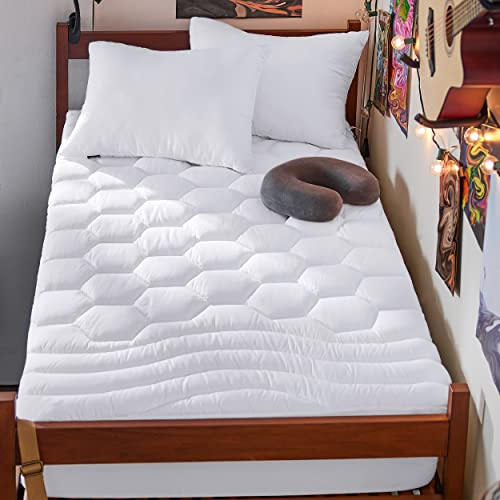 Bedsure Twin XL Mattress Pad – Quilted Cotton Top
↗
Bedsure Twin XL Mattress Pad – Quilted Cotton Top
↗
 Hansleep Twin XL Memory Foam Mattress Topper – 2-Inch
↗
Hansleep Twin XL Memory Foam Mattress Topper – 2-Inch
↗
 Bedsure Twin XL Sheet Set – Dark Grey (4-Piece)
↗
Bedsure Twin XL Sheet Set – Dark Grey (4-Piece)
↗
If you've started reading housing materials from your kid's college, you've probably noticed that every term sounds like it means the same thing — except they don't. Single, double, triple. Suite, pod, corridor. Communal, semi-private, en-suite. Different schools use the same words slightly differently, which is the part that makes it confusing.
Here's a plain-English breakdown of what each term actually means. (And if you want to see how a specific dorm at a specific college is configured — with photos, floor plans, and student notes — that's what we built dormscouter.com for.)
How many people are in the room
Single — One student in one bedroom. The smallest rooms physically, but the scarcest. Usually go to upperclass students, students with documented medical needs, or students who win the lottery.
Double — Two students in one bedroom. Two beds, two desks, two closets. The default at almost every US college and the most common configuration for first-year students.
Triple — Three students in one bedroom. Comes in two flavors: a designated triple (built for three, usually larger, with built-in space for a lofted bed setup) and a forced triple (a double with a third bed jammed in due to a housing crunch). Forced triples are cramped and usually temporary — most schools offer reduced rates and move someone out as soon as space opens up.
Quad and quint — Rare as bedroom configurations. When you see "quad," it more often refers to four students sharing a suite of connected rooms, not all four sleeping in one bedroom. True four- and five-person bedrooms exist mostly at older schools or in honors and themed housing.
How the room connects to the building (dorm style)
Corridor-style (also "hall-style" or "traditional") — A long hallway with bedroom doors lining both sides. Each room is its own enclosed unit; everyone on the floor shares a common bathroom somewhere along the hall. The most social configuration and the one most parents picture when they hear "dorm."
Suite-style — Two to four bedrooms connected to each other by a private living room or vestibule, with a bathroom shared only by the suitemates. From outside the suite, you see one door from the corridor; once inside, the bedrooms branch off a shared common area. A "suite of four" might be two doubles sharing a bathroom — four students total, two per bedroom.
Pod-style — The term that varies most by school. Generally, a small cluster of bedrooms sharing a bathroom — but the cluster is smaller and more bedroom-focused than a suite, and the common space is usually a small lounge rather than a living room. Some schools use "pod" for arrangements where the shared bathroom is accessed from the corridor, but only by a handful of nearby rooms. When in doubt, look at the floor plan rather than the label.
Apartment-style — A self-contained apartment with its own kitchen, living room, bathroom(s), and bedrooms. Usually for upperclass or graduate students. Feels more like off-campus living than traditional dorm life.
House-style — A converted house, brownstone, or small standalone building. Includes Greek chapter houses, language immersion houses, theme houses, and small co-ops. Smaller (8-30 students) and more close-knit than typical dorms.
The bathroom situation
This is the question parents actually care about, and where school terminology diverges most.
Communal — A larger bathroom shared by everyone on the floor. Multiple stalls, multiple showers. Cleaned by housekeeping. The trade-off: no privacy, and you walk down the hall in a robe carrying a shower caddy.
Semi-private (also "suite bathroom") — A bathroom inside a suite, shared only by the suitemates. You don't leave your suite to use it. More privacy, but cleaning is on you.
Pod-style bathroom — A bathroom shared by a small handful of rooms (4-8) but accessed from the corridor, not from inside a suite. A hybrid: more private than communal, less private than a suite bathroom.
Private (also "en-suite") — A bathroom inside the bedroom itself, shared only with your roommate. Usually reserved for upperclass apartments or premium singles.
Building-level identities
These describe what kind of community lives in a building, not how the rooms are physically laid out.
Residential Colleges (RCs) — Yale, Harvard, Princeton, Northwestern, and a handful of others use this model. Undergrads are grouped into "houses" or "colleges" they belong to all four years, each with its own dining hall, traditions, and intramural teams.
Living-Learning Communities (LLCs) — Floors or buildings where students share an academic or extracurricular interest (engineering, sustainability, leadership, etc.). Usually have programming, faculty advisors, and group study spaces tied to the theme.
Language houses — Dedicated to one language, with residents committing to speaking it inside the house.
Honors housing — For students in an honors college or program. Often nicer amenities and better singles.
Theme houses — Built around a shared interest (outdoor adventure, women in STEM, the arts, etc.) — non-language, non-academic.
Substance-free housing — No alcohol, tobacco, or drugs in personal rooms or common spaces, even for residents 21+.
Quiet floors / wellness housing — Extended quiet hours, usually 24/7. Different from substance-free, though they often go together.
Greek chapter houses — Owned or operated by a fraternity or sorority. Members only, often with separate house dues and meal plans.
Cooperative housing (co-ops) — Residents share cooking, cleaning, and maintenance in exchange for reduced rent. More work, more community, much cheaper.
A few other terms worth knowing
Twin XL — The standard dorm bed size: 39" wide by 80" long. Regular twin sheets will not fit — the mattress is five inches longer. This is the single most common bedding mistake parents make.
Lofted bed — A bed raised on a tall frame with usable space underneath for a desk, dresser, or storage. Can be fixed or adjustable.
On-campus vs. off-campus — On-campus is owned and managed by the college. Off-campus can be school-affiliated (e.g. NYU's Brooklyn dorms, Columbia's apartment buildings) or unaffiliated rentals.
Gender-inclusive housing — Roommates and bathroom-shares aren't assigned by gender. Available at most modern colleges as an opt-in.
RA (resident assistant) — An upperclass student who lives on the floor and is the school's first point of contact for residents. Hosts events, mediates conflicts, enforces policies.
How to use this
When reading housing materials, look for three things: how many people are in the bedroom (single, double, triple), how the bedroom connects to the building (corridor, suite, pod, apartment), and the bathroom setup (communal, semi-private, pod, private — and how many people share it). Those three details tell you most of what you need to know about what living there will be like.
For everything else — Photos, floor plans, real student reviews — search the specific building at https://www.dormscouter.com/r/blog.
How to choose a style for yourself
If you're staring at the housing form trying to decide, ask yourself a few honest questions:
- Social or private? Corridors maximize the number of people you'll meet by accident. Apartments maximize solitude and independence. Suites and pods sit in between.
- Bathroom tolerance? Are you okay sharing with 30 strangers down the hall, or do you really want to share with just a few people you know?
- Cooking or meal plan? If you want to cook regularly, you need an apartment or at least a building with a real shared kitchen — not just a microwave alcove.
- Friend group strategy? Some students want to meet a wide range of people organically (corridor culture); others want to curate a tight crew who become their default (suite, pod).
There's no wrong answer — just a right answer for how you actually want to live.
Looking for real photos, floor plans, and student reviews of specific dorm rooms? Search your school at DormScouter — a free, growing library of dorm reviews from the students and parents who've actually lived there.
💬 Comments & Tips